READING NOTE · UPDATED 2026
Make a strategy understandable before organising it
5S can suggest ways of making information easier to find and maintain, but a tidy strategy document is not an aligned strategy. Use this article to examine contradictory priorities, obsolete assumptions and decisions that have no owner. Keep the human negotiation of priorities visible rather than reducing strategy to document housekeeping.
A practical next step
- List the active strategic commitments.
- Identify an obsolete or conflicting commitment.
- Agree who will resolve it and when the decision will be reviewed.
This 2026 reading note is written by the Durnall editorial team. Richard Durnall’s original text follows below.

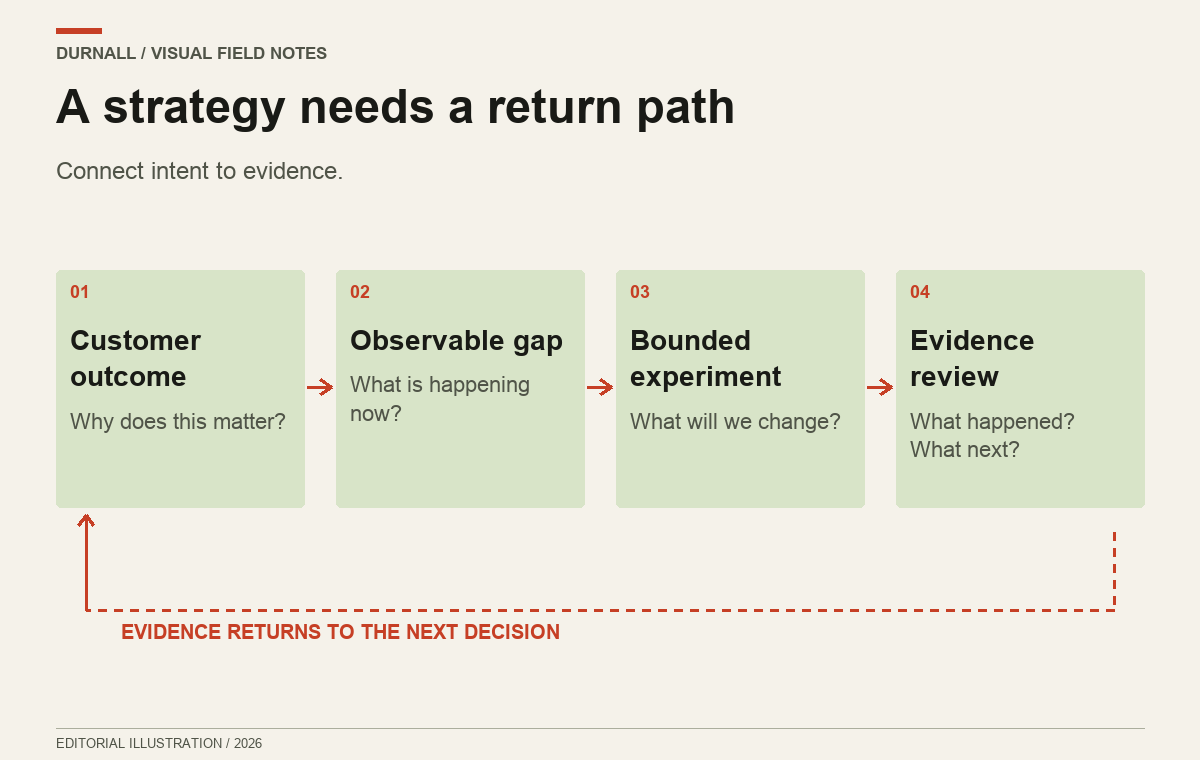
Read the diagram as text
Connect a customer outcome to an observable gap, a bounded experiment and a review. Return the evidence to the strategy discussion instead of treating a plan as proof of progress.
Original publication: .
Original WordPress feed timestamp, UTC; the old theme’s local date may differ. Check the date source ↗
The original words below retain their period and attribution. The reading note above is the current editorial addition.
Source capture · 2008-02-20 ↗I’m going to take a break from looking at Lean process principles and talk about a really practical application I’ve found of one of the tools used by Toyota. Let’s apply the 5S to IT strategy and in particular a strategic view of application portfolio management.
The 5S
The 5S are five terms beginning with ‘S’ that are used to create a workplace suitable for visual control and Lean production. This is the point that it gets a bit weird though because the translations of the terms to English seems to have been interpreted quite broadly and there are lots of different versions. Below are what I believe are the most accurate translations of the terms to English….
Seiri :: separate needed from unneeded items.
Seiton :: neatly arrange what is left - ‘a place for everything and everything in its place’.
Seiso :: clean and wash.
Seiketsu :: cleanliness resulting from the first 3S’s.
Shitsuke :: discipline to perform the first 4S’s.
For IT strategy work I like to use a translation of the terms that I don’t believe is as pure as the one above but works really nicely in an IT context. This model focuses on the assessment of the existing application portfolio rather than planned projects or programs of work, however it can be used as a high-level framework for both…
Sort
Sort through the exisitng applications in the enterprise categorising them by the criteria that are important to you (platform, business process supported, business units the system is used by). This is an identification and categorisation exercise.
Set in Order
Prioritise the value of the applications based on the value of the processes that they support and expected returns. Try to implement plans to remove any unneeded systems or unneeded components of systems at this stage. Assess the alignment of the applications to the business processes they support and the business strategy. Identify the frequency of enhancements to the system and the likelihood for future change. We now have a categorised and ordered portfolio.
Shine
Put in place activities to remediate any problematic technical debt in high-value, high frequency of change applications. Develop metrics to monitor the cleanliness of the portfolio such as average cost or cycle time per change. Introduce instrumentation to help monitor the health of the applications at this point (test coverage %, cyclomatic complexity…).
Standardise
Standardise technology platforms where appropriate to reduce total cost of ownership. Put in place plans to consolidate applications and simplify the portfolio as much as possible. This is usually part of a long-term strategic outlook.
Sustain
Put in place plans to sustain the health of the portfolio, perform regular monitoring of performance and perform regular, at least annual, refreshes of the portfolio strategy.
Within this framework we can then apply other IT strategy tools to ensure business alignment, strategy alignment and a long term outlook for our application portfolio and new projects. I like it as a simple framework to perform these kind of activities. I’m always interested in any similar models that you are applying…