THE READING ROOM · UPDATED 2026
Ideas you can
put to work.
Richard Durnall’s original articles and references, with current reading notes and practical next steps. New field guides sit alongside the original writing.
Filtering needs JavaScript. All article and reference links remain available below.
52 original texts
5S for IT Strategy
3 min02Richard Durnall · reading note updated 2026A3 Reports
1 min03Original reference · reading note updated 2026About Me
7 min04Richard Durnall · reading note updated 2026Agile Adoption Patterns
4 min05Richard Durnall · reading note updated 2026Agile Alliance Australia – Meetings
1 min06Richard Durnall · reading note updated 2026Agile Australia 2009
1 min07Original reference · reading note updated 2026Agile Glossary
5 min08Richard Durnall · reading note updated 2026Agile Glossary
1 min09Richard Durnall · reading note updated 2026Agile Readiness Assessments
4 min10Richard Durnall · reading note updated 2026Agile XP
3 min11Richard Durnall · reading note updated 2026Australian Architecture Forum 2008
2 min12Richard Durnall · reading note updated 2026Dzone Lean Article
1 min13Richard Durnall · reading note updated 2026Frog & Bike Thinkers
4 min14Richard Durnall · reading note updated 2026From Push to Pull
4 min15Richard Durnall · reading note updated 2026Google 2007 Financial Results
2 min16Richard Durnall · reading note updated 2026Hoshin Kanri
3 min17Richard Durnall · reading note updated 2026Interview: Lean Software Development with Kent Beck
3 min18Richard Durnall · reading note updated 2026Interview: Lean Software Development with Mary Poppendieck
6 min19Richard Durnall · reading note updated 2026Interview: Lean Thinking with Owen Berkeley-Hill
15 min20Richard Durnall · reading note updated 2026Interview: SEO with Rand Fishkin
5 min21Richard Durnall · reading note updated 2026Japanese Management Theory
1 min22Richard Durnall · reading note updated 2026Kanban
3 min23Richard Durnall · reading note updated 2026Lean 2008
1 min24Richard Durnall · reading note updated 2026Lean From The Top…
3 min25Original reference · reading note updated 2026Lean Glossary
13 min26Richard Durnall · reading note updated 2026Lean IT Glossary
1 min27Richard Durnall · reading note updated 2026Lean IT Presentation
1 min28Richard Durnall · reading note updated 2026Lean Software Development (LSD)
5 min29Richard Durnall · reading note updated 2026Lean Software Development Video
1 min30Richard Durnall · reading note updated 2026Lean vs Agile
5 min31Richard Durnall · reading note updated 2026Learning to Learn
1 min32Original reference · reading note updated 2026Media
1 min33Richard Durnall · reading note updated 2026New Book :: Toyota Culture
1 min34Richard Durnall · reading note updated 2026Objects of Desire: Fano RB6
1 min35Richard Durnall · reading note updated 2026Offshore Agile
2 min36Richard Durnall · reading note updated 2026Organisational Design
4 min37Richard Durnall · reading note updated 2026Presentation: Restructuring IT (Ross Pettit)
2 min38Richard Durnall · reading note updated 2026Presentations
1 min39Richard Durnall · reading note updated 2026Pull Systems
5 min40Richard Durnall · reading note updated 2026Push Systems
4 min41Richard Durnall · reading note updated 2026Reading List
1 min42Original reference · reading note updated 2026Reading List
1 min43Richard Durnall · reading note updated 2026Reflections on Agile 2008
11 min44Richard Durnall · reading note updated 2026Reflections on Lean 2008
3 min45Richard Durnall · reading note updated 2026Search Engine Optimisation (SEO)
4 min46Richard Durnall · reading note updated 2026Size Matters
1 min47Richard Durnall · reading note updated 2026Systems Management Theory
1 min48Richard Durnall · reading note updated 2026The IT Division. Refactored.
2 min49Richard Durnall · reading note updated 2026Top 200 Blogs for Developers
1 min50Richard Durnall · reading note updated 2026Waste / Muda
5 min51Richard Durnall · reading note updated 2026Welcome to ‘The Lean Tool Age’
3 min52Richard Durnall · reading note updated 2026What is Lean?
3 minNo matching titles. Try a broader topic.
Practical field guides
Set a WIP limit your team can actually use
A practical experiment for controlling work in progress: define boundaries, handle blocked work and review flow without turning the limit into a target.
Read the guide ↗FIELD NOTE 02 / PROBLEM SOLVINGAn A3 for a problem that keeps returning
Write a concise A3 for digital work: establish the gap, separate observations from hypotheses and design a checkable countermeasure.
Read the guide ↗FIELD NOTE 03 / STRATEGYConnect a strategic goal to a testable change
A working strategy-to-experiment map: connect outcomes, observations, owners and review decisions without building a cascade of disconnected targets.
Read the guide ↗FIELD NOTE 04 / AGILEMake Agile adoption a learning experiment
A practical adoption plan for one team: choose a real delivery problem, create feedback and review consequences before expanding a practice.
Read the guide ↗FIELD NOTE 05 / SYSTEMS THINKINGMap one piece of work before mapping everything
Follow one completed request through a digital service, distinguish work from waiting and choose an observation-led improvement experiment.
Read the guide ↗FIELD NOTE 06 / CONTINUOUS IMPROVEMENTLeave the retrospective with one test
A focused retrospective format that turns a specific observation into a reversible test, an owner and a review decision.
Read the guide ↗Choose a reading path from a recurring work problem
Use the catalogue to resolve one practical question rather than reading every guide before acting. This route begins with a fictional problem: “Requests reach review, then nobody can say what they are waiting for.” It links current field guides without rewriting Richard Durnall’s historical articles or treating a reading list as an implemented improvement.
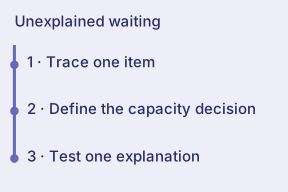
- Find the boundary: read Map one piece of work. Produce one trace from request to useful delivery, with known states, dates and unknown intervals. If the team cannot reconstruct the item, stop and obtain those observations; do not invent a bottleneck.
- Make a decision at capacity: read Set a WIP limit. Write what “started” and “finished” mean and what happens when the agreed review boundary is full. Keep blocked items inside the count where they remain within that boundary. A chosen cap is a trial agreement, not an optimal number discovered by the article.
- Test the explanation: read An A3 for a recurring problem. Separate the observation from the proposed cause, choose a reversible countermeasure and agree what would count against it. Leave the result unresolved until the trial runs.
Completed route card — fictional: the trace identifies an item waiting for an acceptance decision, but does not establish why. The team’s working hypothesis is that review requests lack an explicit decision owner. Its proposed test is to name that owner before the next agreed set of comparable handovers enters review, while keeping the existing capacity policy visible. If owners are named but the decisions still stall, the hypothesis is incomplete; inspect authority, availability or unclear criteria before repeating the same fix.
The next reading follows the unresolved question. If the item history is missing, return to the trace. If capacity exceptions hide unfinished work, return to the WIP agreement. If the evidence contradicts the proposed cause, revise the A3. The route is finished when it yields a reviewable next action, not when every linked page has been opened.
Route card: recurring problem ___; chosen item and boundary ___; observation still missing ___; first guide and output ___; policy decision needed ___; hypothesis ___; proposed test ___; evidence that would contradict it ___; owner/review date ___; next reading or stop ___. No business outcome is inferred from completing this card.
The Kanban Guide, May 2025: explicit workflow boundaries and improvement