
Read the diagram as text
Name a real problem, choose one practice, state a hypothesis, run a bounded trial, inspect evidence and decide whether to adapt, stop or extend. A method name alone is not a result.
Name the problem→02
Try a practice→03
Review results
Before adopting a framework, ask what you need to learn. A team with delayed customer feedback has a different problem from one with frequent production incidents. Both might benefit from a new practice, but a common ceremony calendar will not explain the mechanism. Start with the problem people can observe, then choose a limited experiment.
Choose one working boundary
Pick a service, product area or stream of requests where the team can review the work together. Identify who decides what is useful, who can make a change and who accepts the result. A boundary that excludes every approval and handoff may create a flattering local picture while hiding the customer's actual wait.
The Agile Manifesto's principles emphasize valuable working software, collaboration, sustainable work and regular reflection. They supply a reference point for the experiment. They do not prescribe a score that proves a team is Agile. Avoid announcing a maturity level when you have only measured attendance at meetings.
Write a hypothesis people can challenge
For an illustrative team, the hypothesis might be: “Showing a usable increment to the people receiving the service will reveal misunderstandings before the next large release.” Decide what a usable increment means in that context. A technical component with no way to exercise the intended behavior may not provide the feedback you need.
Write down what would count against the idea. Perhaps the feedback arrives from people who cannot represent the intended users. Perhaps a shorter delivery interval exposes an unmanageable testing constraint. These observations are useful learning, not reasons to conceal the result.
A trial plan
- Collect two or three recent examples of the delivery problem.
- Choose one change in the way the team works.
- Name the feedback partner and an accessible demonstration format.
- Record what you expect to learn and what evidence could challenge it.
- Agree on a review time that includes meaningful work.
- Compare the experience, quality and workload; decide the next change.
Make room for the work
Do not simply add demonstrations, retrospectives and planning sessions to an already full calendar. Identify a meeting or report the trial replaces. If no activity can be stopped, make the additional burden visible and decide whether the trial is feasible. Sustainable work is a design constraint, not an aspiration to include in the launch presentation.
Review a concrete example
At the review, choose an actual item that passed through the experiment. What decision changed because of feedback? How much rework followed? Who had to wait? Did someone outside the team inherit extra coordination? This is more informative than a general statement that everybody enjoyed the new process. Keep the observations separate from the interpretation.
The historical Agile Adoption Patterns and Agile Readiness Assessments entries are useful discussion material. Their original context belongs to the earlier blog. Our 2026 trial plan is an independent editorial guide, with no claim of participation by the historical author.
Decide how to expand
If the trial produces useful learning, expand the practice with its conditions attached: the boundary, the feedback relationship and the constraints. Another team should be able to adapt those conditions rather than copy a ritual. If the result is inconclusive, say so and choose the next observation. A credible adoption story includes changes that did not help.
Primary reference
Principles behind the Agile Manifesto ↗. Consulted 4 October 2026. Procedures and training examples above are editorial proposals; examples are illustrative and are not claimed business results.
Write the observation that would stop the trial
A trial with no possible stopping observation is difficult to learn from. The example below turns a vague wish for faster handovers into a bounded review. All counts and deadlines are invented; they are not results from Richard Durnall or a client.
- State a mechanism before a target. In this example, a visible owner field is expected to reduce stalled handovers caused by missing ownership. Faster delivery overall is a different claim and is not tested by the small exercise.
- Define what counts as a handover, “stalled”, and a recorded owner before observing. Choose a review window and an agreed way for affected people to raise a concern; do not change definitions after seeing the counts.
- Write both continuation and stopping questions. Compare the observation with the proposed mechanism, then decide to stop, revise or gather more evidence. Keep the inconvenient observation in the same record as the hypothesis.
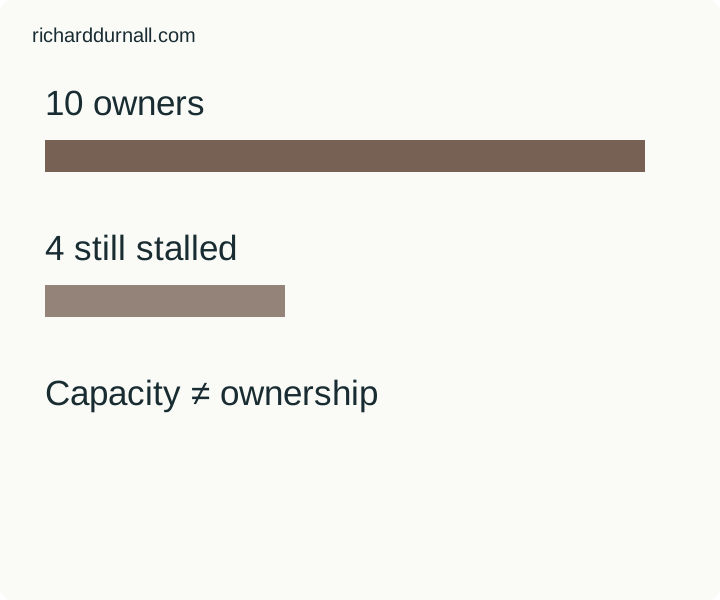
Worked record
| Hypothesis — fictional | Adding an owner field will address handovers stalled because nobody knows who acts next. |
|---|---|
| Review window | Ten eligible handovers during an agreed trial; stalled means unresolved next owner at the agreed check, not simply unfinished work. |
| Counter-observation | All ten have named owners, yet four still stall because the receiving queue has no capacity. The ownership mechanism does not explain those four. |
| Decision | Do not expand the field as a solution to queue capacity. Retain useful ownership clarity if agreed, then investigate capacity separately. |
| Reusable record | Mechanism __; definition __; window __; stopping observation __; actual evidence __; affected people’s concerns __; stop/revise/continue reason __. |
Ten observations cannot establish a general causal effect. The Agile Manifesto supplies a historical principle about reflection and adaptation; the explicit stopping record here is a new editorial exercise.
Primary sources: Principles behind the Agile Manifesto