READING NOTE · UPDATED 2026
Translate principles into observable work
Lean software development becomes useful when a principle changes a decision. Eliminating waste, learning quickly and respecting people require evidence from the delivery system. They should not become a justification for understaffing or rushing untested changes. The historical introduction below can be read alongside a current, bounded improvement experiment.
A practical next step
- Describe the customer outcome, not a utilisation target.
- Find one delay or recurring source of rework.
- Agree on a reversible change and its review date.
This 2026 reading note is written by the Durnall editorial team. Richard Durnall’s original text follows below.

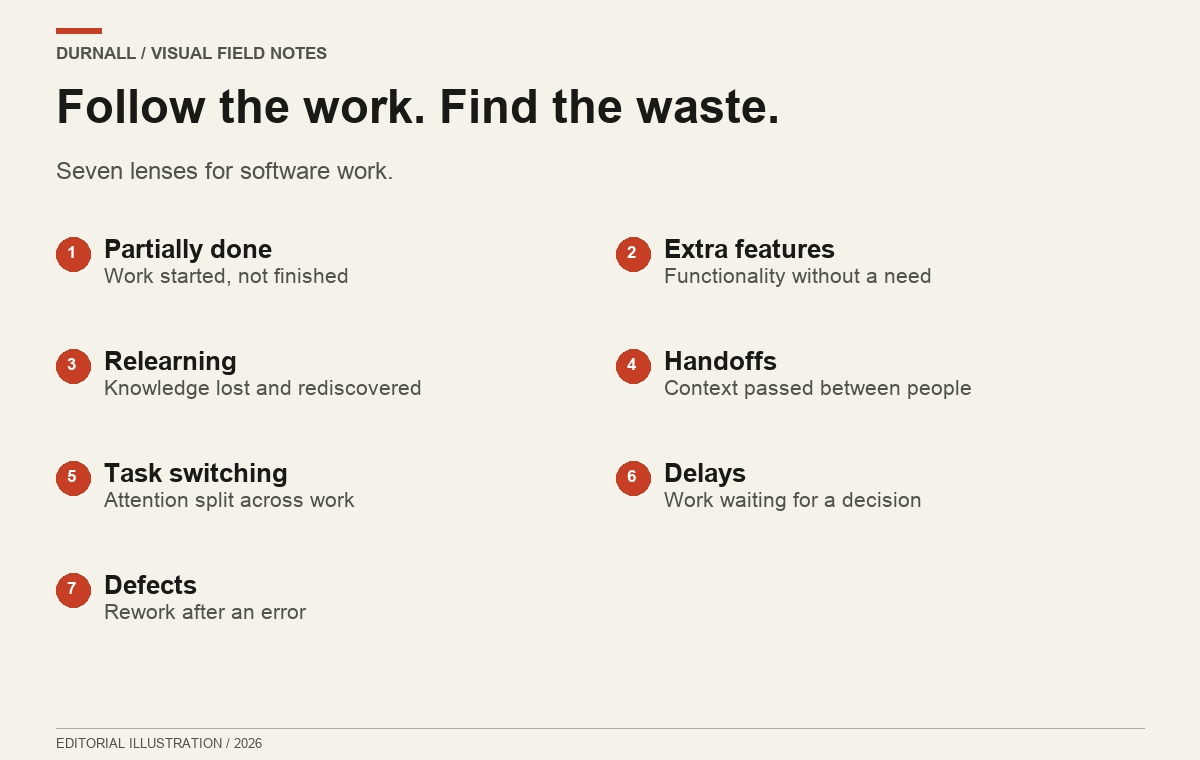
Read the diagram as text
Look for partially done work, extra features, relearning, handoffs, task switching, delays and defects. These are observation prompts, not a scorecard for judging people.
Original publication: .
Original WordPress feed timestamp, UTC; the old theme’s local date may differ. Check the date source ↗
The original words below retain their period and attribution. The reading note above is the current editorial addition.
Source capture · 2008-01-09 ↗Lean Software Development is a relatively new area and has a slightly odd history but an interesting one. It’s probably worth starting off by looking at Lean and to do that we need to understand a bit about Toyota… but to do that we need to look at my ex-employer, the machine that is Ford Motor Company.
In June 1903, Henry Ford and a group of collaborators and investors reincorporated as Ford Motor Company. Henry Ford was a prolific inventor with a vision of providing motor vehicles for the masses rather than the elite and hobbyists who had been the only market to date. On his way to achieving his vision, Henry Ford introduced a number of innovations including the five-dollar day, the moving assembly line and vertical integration (developing all parts and components in-house). Henry Ford achieved his vision by reducing variation (”you can have any colour your want as long as it’s black”) and leveraging economies of scale through large product volumes to produce cost effective vehicles en masse. The important things to note are that large volumes and low variation were the key to Henry Ford’s mass manufacturing blueprint. Meanwhile, back in Japan…
Sakichi Toyoda had been making looms that were cheap and worked better than existing looms since around 1894. He liked his looms but didn’t like that his mom and gran had to work hard to use these manual looms so he set his mind to creating automated looms and a means of powering them. Sakichi Toyoda soon mastered the automated loom and in 1926 he created Toyoda Automated Loom Works. Sakichi Toyoda’s achievements were that he created a culture of hard work and innovation that generated a legacy and that he understood that the future did not belong to automated loom production; in 1929 he sent his son, Kiichiro to negotiate the sale of the highly successful ‘mistake-proof’ loom to an English company and in 1930 used the profits to create The Toyota Motor Corporation.
In 1945 World War II ended, the Japanese had lost and the Americans were occupying Japan. Kaiichi Toyoda was facing some economic conditions that made business tough. Inflation was rampant and costs had to be totally minimised, variation in vehicles was important to the local market but scale was limited due to trade restrictions and local demand was limited due to most of the country having been smashed by two atom bombs. Yet these were the conditions that led to the development of what is probably the most powerful production system ever developed; necessity really is the mother of invention.
Following World War II the Allies supported the Japanese in the rebuilding of the economy by allowing Japanese convoys to visit overseas businesses. Eiji Toyoda toured US manufacturing facilities including The River Rouge complex owned by Ford Motor Company; Eiji also visited some large supermarket chains that had started to apply principles that would later become known as just-in-time. The allies also provided coaching on a system known as Training Within Industry (TWI) that had proved an effective tool in the supply of the allied war effort.
Fast forward to the eighties and the big three automotive companies (Ford Motor Company, General Motors & Daimler Chrysler AG) in Detroit suddenly realise that Toyota isn’t just nibbling away at their lunches but taking dirty great bites from under their noses. Initial investigations from the big three suggest various reasons for the rise of Toyota: trade barriers, government interference, cultural differences etc. Over time each of these excuses was either removed or rejected. When James Womack, Daniel Jones & Daniel Roos published their study of the industry ‘The Machine That Changed the World’ in 1990, the answer became clear; Toyota were just better. The Toyota Production System (TPS) hit the world.
In 1996 Kent Beck, an IT consultant, was working at Daimler Chrysler AG on a project called the Chrysler Comprehensive Compensation System (C3) and was no doubt aware of the business challenges that Chrysler was dealing with in the face of ever increasing competition from Toyota. Each of the big three were making production system changes at this time to deal with the new competitive landscape they were facing. Kent Beck, along with his co-conspirators, defined a new process that knowingly or unknowingly (I suspect the former) applied a lot of the principles and practices of the Toyota Production System to the software delivery context. This process became known as Agile XP and has developed into a popular software delivery methodology that is widely used and constantly growing in its usage. The work at Chrysler also catalysed the creation of a family of similar methodologies such as Scrum, Crystal and DSDM that are often collectively referred to as Agile Methodologies.
So, back to the present. Agile methodologies are in popular use and gaining in popularity at a rapid rate, however many current practitioners are not familiar with the lean principles that contributed to its development. The Lean Software Development community is returning to these foundations and using them to improve the software we deliver, the processes we use to deliver them and the effectiveness of the underlying processes our systems support.
I believe that the purpose of the Lean Software Development community is to use lean principles to:
(1) Improve the processes used to develop software. Faster, better, cheaper.
(2) Improve the end-to-end business processes that are supported by our systems and the products these processes deliver to the consumer.
Welcome aboard!